
Japan
Japan Mainshock Forecasts
Northern Honshu
Official research shows that a megaquake is likely to hit Northern Honshu in the near term and Japanese authorities have already warned their people to be prepared (Megaquake advisory ended in Japan, but officials say disaster risk remains | NHK WORLD-JAPAN News).
From independent research, https://www.mainshockearthquakes.com, and based on events to July 19, 2026, this author forecasts that an M 8.4 earthquake is due in Apr 2027 in the region from offshore Northern Honshu to Hokkaido – a zone adjacent to the junction of the Japan and Kuril-Kamchatka Trenches.
This forecast is supported from four independent modelling approaches developed by the author, including the new Triangular Analytical Module and breakthrough in its application to forecasting.
Explanation and Discussion of the Triangular Module
Development of the Triangular Analytical Module is fully described on the page of this website devoted to it, and its application to earthquake forecasting is repeated here for convenient reference in relation to the figures below which compare past and current patterns in the largest yearly and monthly earthquakes since Honshu’s M 9.1 mega-earthquake of Mar 2011.
The Module demonstrates how simultaneous geometric triangulations provide accurate retrospective forecasts for Japan’s previous mega-earthquake compared with new prospective forecasts, yet to be evaluated by this author, from a corresponding study of current earthquakes.
Key features of the new Triangular Analytical Module (as illustrated in the figures below) show the potential ability to forecast both the timing and the magnitude of a forthcoming mainshock from simultaneous triangulations in one geometric module, and with potential confirmation from annual and monthly modules.
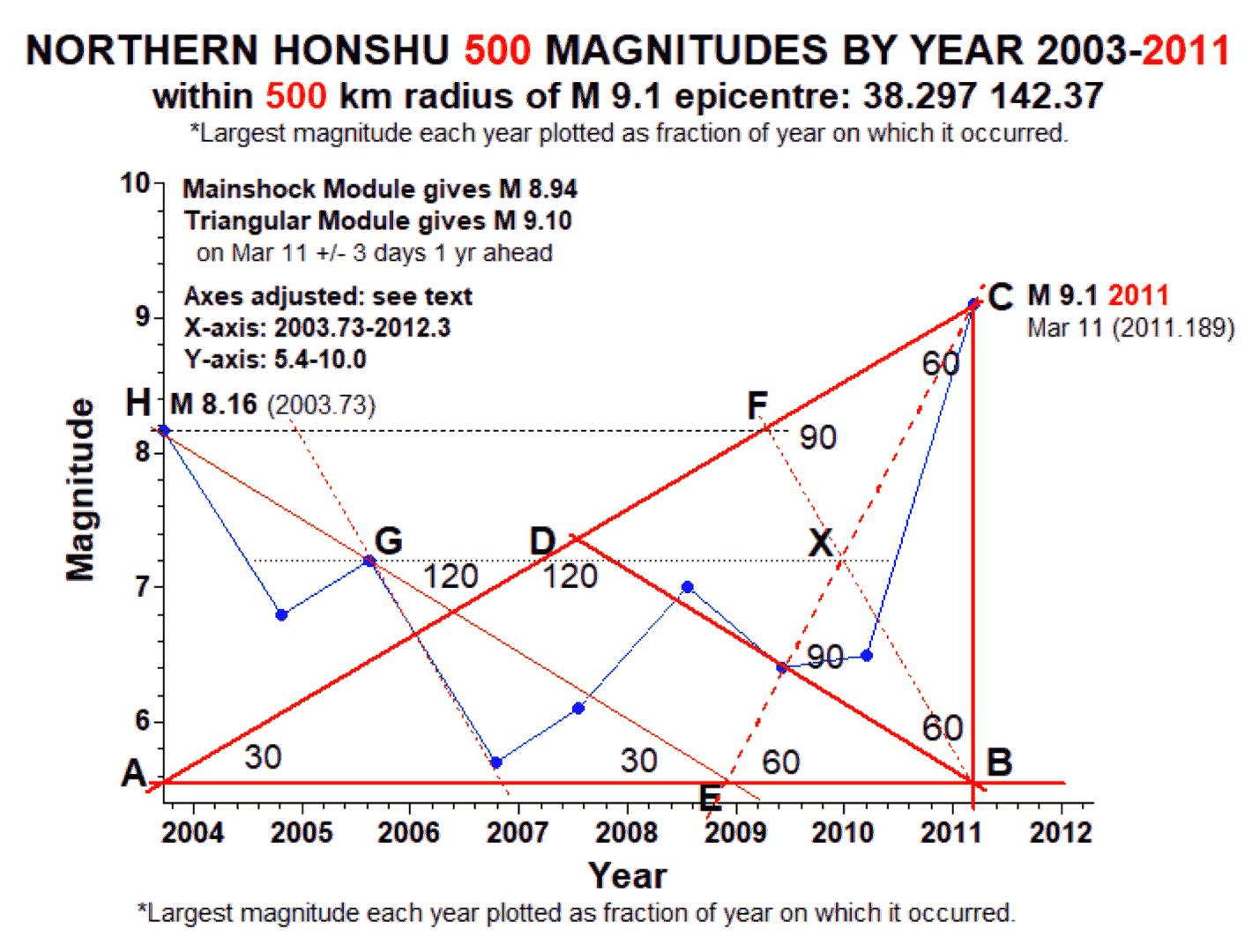
Figure 1.
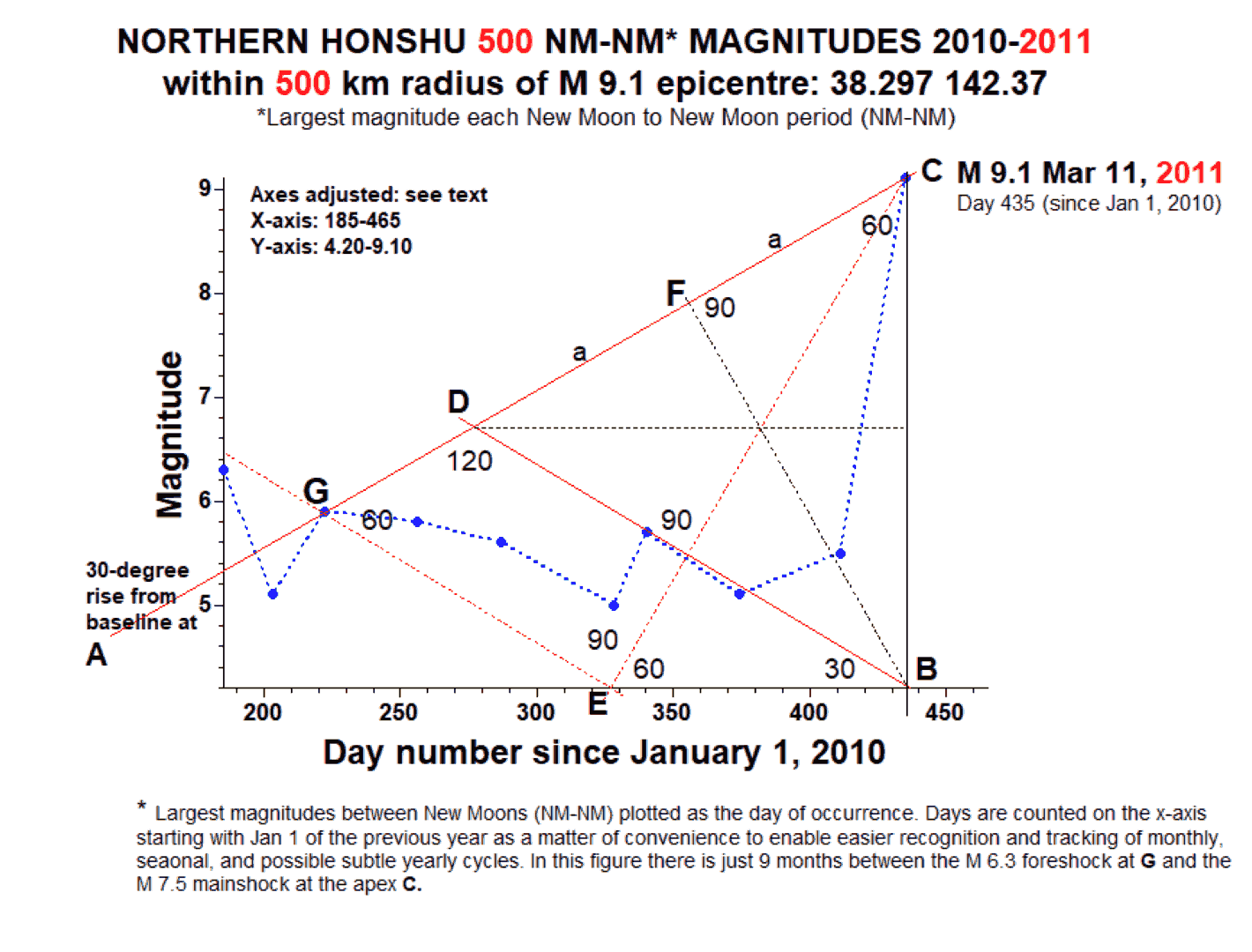
Figure 2.
Forecast Revised following M 6.9 earthquake June 24, 2026

Figure 3
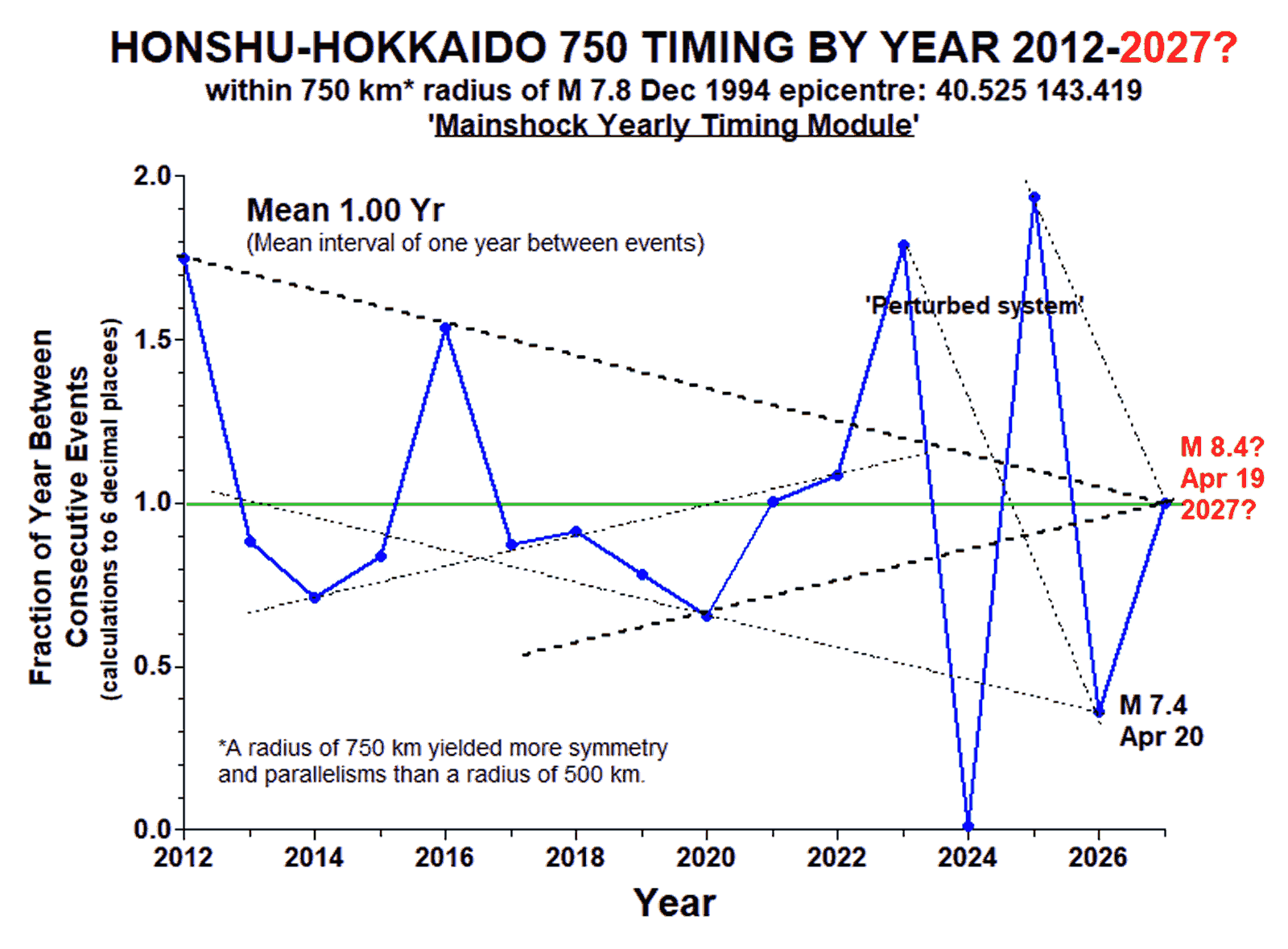
Figure 4
Mainshock’s Date and Magnitude
Key features of the new Triangular Analytical Module are given below and show the potential ability to forecast the timing and magnitude of a forthcoming mainshock from two simultaneous triangulations in one geometric module, and with potential confirmation from annual and monthly modules.
Mainshock’s Date & Magnitude given simultaneously by two triangulations:
The Date of a Mainshock is given by triangulation at B on the baseline.
a) The date B for the next mainshock is given by where DB intersects base AB.
b) The line FXB (theoretical or not) must intersect the baseline at B.
c) At the intersection of the perpendicular CB which forms the 60-deg angle ACB subtended from C.
The Magnitude of a Mainshock is given by triangulation at C on the apex.
a) On a 30-deg rise from baseline AB to C and often including a major foreshock.
b) At the intersection of AC & EC, the latter being either theoretical or actual and arising at an angle of 60 degrees from AB to join C. Major foreshocks may also occur on EC.
c) At the intersection with the perpendicular BC from the appropriate date B.
Axes are adjusted so that AC & DB, by triangular theory, form 30-deg angles with AB and thus 120 degrees at D; then, the intersection of DB and AB gives the date (day number) of the mainshock at C which subtends the 60-deg angle ACB. When the axes are being adjusted, DX is important as it should intersect where EC and FB cross over, whether these lines are theoretical or not.
The 60-deg angle ACB is divided by EC which crosses the important line DB at an angle of 90 degrees and as shown in Figures 1-2, EC arises from baseline AB where it is intersected at 90 degrees by GE. Horizontal lines HF and GX highlight key intersections through which theoretical lines can be drawn if data are lacking.
Discussion of Figures 3-4
Recent large earthquakes have shifted the focus of the author’s studies from being centred on the coordinates for Japan’s M 9.1 of 2011 to a position 265 km* north by arbitrarily choosing the coordinates for the M 7.8 of Dec 28, 1994, (Lat 40.525, Lon 143.419) to shift the focus to events surrounding the seismically active junction of the Japan Trench and the Kuril-Kamchatka Trench which is south to south-east of Hokkaido.
Figure 3 shows the sequence of largest annual earthquakes since Honshu’s M 9.1 of 2011 and within a radius of 500 km from the author’s above new study centre, east of Hachinohe in Northern Honshu, and at the northern end of the Japan Trench, near its junction with the Kuril-Kamchatka Trench.
This zone has recently experienced two major earthquakes little over four months apart: firstly, the M 7.6 near the northern tip of Honshu on Dec 8, 2025, only 108 km west of the M 8.2 of 1968 and, secondly, the M 7.4 of Apr 20, 2026, which hit further south at a latitude of 39.971 which is very close to the epicentre of the M 8.0 of 1960, also about 200 km north of the M 9.1 mega-earthquake of 2011, and only some 145 km northwest of the devastating M 8.4 Sanriku Earthquake of 1933.
These above events are likely to be forerunners to another M 8.4 in Apr 2027 as forecast by the author’s Triangular Analytical Module (Figure 3) and supported independently by three other analytical modules – the Mainshock Module, the Foreshock Module, and the Ratio Module with their mean of M 8.4 also forecast.
The Mainshock Yearly Timing Module (Figure 4) shows the expected convergence of the time between largest yearly events towards ‘unity’ or around one year between the penultimate mainshock event and date of the expected mainshock. There is also the classical disruption of timing intervals close to that for the forecast mainshock which here has the same date yielded by both Figures 3 and 4: at this stage (July 17, 2026), the provisional forecast is for an M 8.4 mainshock due about Apr 19, 2027 (Figure 3: 2027.3) – just one year after the M 7.4 foreshock of Apr 20, 2026.
*All measurements are approximate and, unless otherwise stated, are taken off Google Earth Pro.
Latest page update July 21, 2026 (UTC).