
Tonga
Photo by Nandeenee Naiken on Unsplash
On May 3, 2006, Tonga bore shaking from a massive M 8.0 earthquake at Lat -19.97, Lon 174.27, about 47 km SSE of Pangai and west of the Tonga Trench. Despite the magnitude there was ‘limited damage’ and only one casualty (2006 Tonga earthquake - Wikipedia).
The USGS says (USGS network: M 8.0 - 47 km SSE of Pangai, Tonga) “At the location of the earthquake, the Pacific plate subducts westward beneath the Australia plate at a velocity of about 77 mm/yr”. This USGS site also says that a tsunami with wave height of 0.54 metres hit at Pago Pago, and that this peak was also reached at Crescent City, California.
The author of this website now presents evidence below which indicates a likely recurrence of a similar large earthquake during 2027. The original forecast for an M 8.2 in 2026 is withdrawn because of the M 7.5 of Mar 24, 2026, and its effects on updated modelling.
Recent large quakes (2022-2026) within 350 km of Pangai (Lat -18.656, Lon -173.966) were an M 7.3 in 2022 (236 km east of Pangai), an M 7.0 in 2025 (60 km south) and an M 7.5 on Mar 24, 2026 (186 km northwest of Pangai). These earthquakes are shown below on the Google Earth Pro map in relation to Tonga’s previous M 8.0 of 2006.
Figure 1 (below) demonstrates application of the Triangular Analytical Module to the largest annual earthquakes within a radius of 500 km preceding Tonga's M 8.0 in May 2006. This retrospective modelling shows the amazing potential of this methodology to provide accurate forecasts of the magnitude and timing of major earthquakes, up to a year before their occurrence.
This analysis also provides an opportunity to test other forecasts (as given by the author’s three research modules listed on Figure 1) against a large mainshock which has already occurred: the results are excellent with a mean forecast of M 8.03 (SE 0.064) based on other estimates from the Mainshock Module, Foreshock Module, and Ratio Module.
The Triangular Module contains the equilateral triangle BCD which includes important triangulations at its three apices plus a fourth triangulation at its mathematical ‘orthocentre’ X.
All four triangulations must be simultaneously present to achieve a correct forecast, and this is achieved by iterative adjustment of the axes knowing in advance from the Mainshock Module the approximate magnitude to be expected apex C of the Triangular Module. This knowledge always allows provisional placement of the lines and angles expected in analyses with this module. In regard to triangulations, it is important to note that geometrically-important theoretical lines have precedence over lines fitted to earthquake data points.
Other Key Findings from Figure 1
Mainshock Analytical Module Performance
The author's Mainshock Analytical Module is robust, producing an estimate for the magnitude of the 2006 Tongan M 8.0 mainshock that closely matches the actual value. This reliability is notable given the unpredictable variation in event sizes throughout the sequence, where each data point contributes to the mathematical and statistical analyses. These analyses are grounded in a conceptual framework inspired by Newton's principle: for every action, there is an equal and opposite reaction.
Identification of the Critical Precursor
The lowest yearly magnitude recorded in the sequence of largest earthquakes for each year—the M 6.1 in 2005—is designated as the author's mathematical 'Critical Precursor' (CP) for modelling purposes. This designation is also conceptually based on the Newtonian principle outlined above.
Mathematical and Spatial Importance of the Critical Precursor
The Critical Precursor is both mathematically and spatially important. It usually occurs within 250 kilometres of the subsequent mainshock. In this example prior to the M 8.0 of 2006, with a search zone radius of 500 km, the M 6.1 CP was located only 33 km southwest of the M 8.0 mainshock. However, adjusting the size of the search zone can alter the CP's position.
Position of the Critical Precursor in Aftershock and Foreshock Sequences
The Critical Precursor usually lies around the divide between aftershock and foreshock magnitude sequences (like the M 6.2 of 2002), but the M 6.1 in the penultimate year of 2005 was the lowest point and therefore becomes the Critical Precursor (CP). The author’s studies of well over 100 inter-mainshock annual sequences have shown that the CP quake can occur at any time in a sequence, even in the year immediately following the previous mainshock in a specified region.
Magnitude Drop Prior to Mainshock
A strong drop in magnitude in the penultimate year is the norm, and this pattern is clearly demonstrated in the sequence analysed.
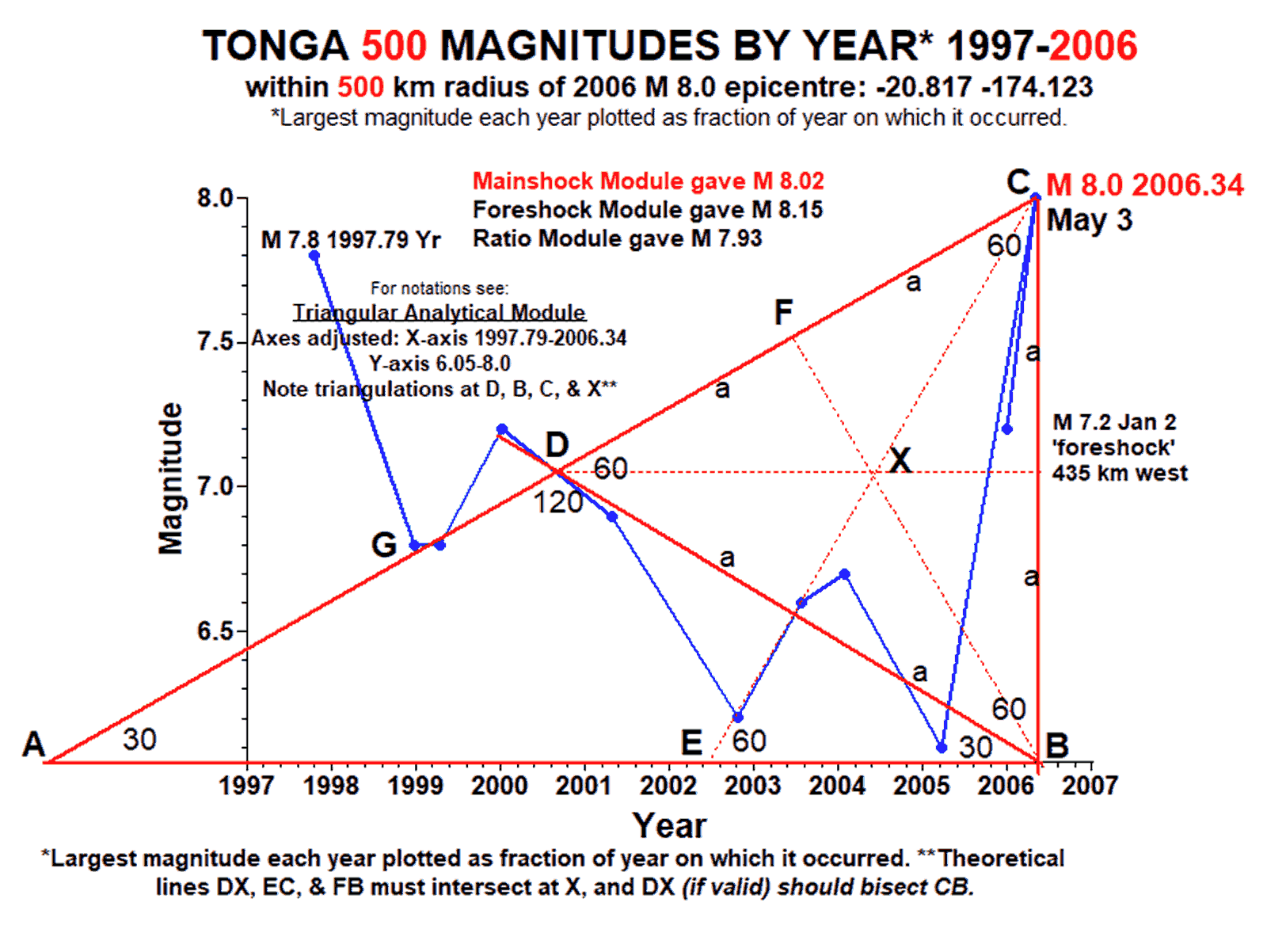
Figure 1
The sequence of lines and angles to be drawn – Figure 1.
Draw DB from or through mid-sequence event at or near D. This principal line DB (at 30-deg to baseline AB) gives the date (day no.) of the mainshock at B.
Draw BC, the perpendicular leg of triangle ABC, which arises from the intersection of DB with baseline AB.
Draw FB at 30-degrees to DB and 90-degrees to DC.
Draw DX horizontally to bisect the perpendicular BC, and then ultimately EC and FB must intersect at the common point X which is the mathematical 'orthocentre' of the equilateral triangle DCB.
Draw EC at 60-deg from AB to intersect at X.
Draw CA, the hypotenuse, to form a 60-deg angle subtended from apex C, between CA and CB, 90-deg at F, and 120 at D.
Draw AB, the horizontal baseline leg of triangle ABC, after the above angles and intersecting lines have determined the position and value of B.
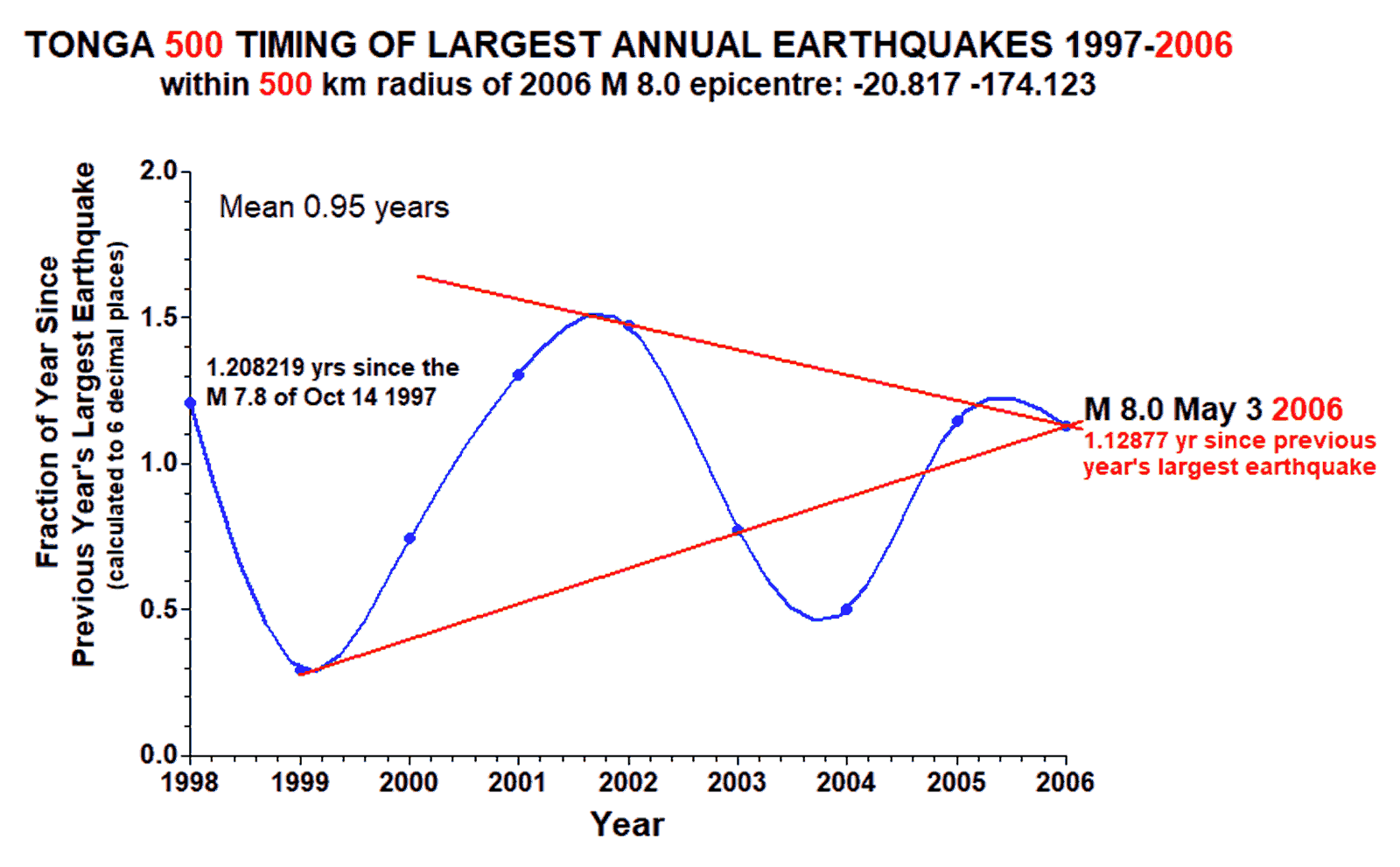
Figure 2
MAINSHOCK YEARLY TIMING MODULE (Figure 2)
The graphical analysis of Figure 2 is an example of the Mainshock Yearly Timing Module, an additional method designed to estimate the likely timing of a mainshock earthquake. It achieves this by analysing variations in the time intervals between the largest earthquakes recorded each year. This additional approach to forecasting provides an evidence-based estimate for when the next mainshock could occur.
The module plots the time in days between the largest earthquakes in consecutive years, expressing this as the fraction of a year (to six decimal places) since the previous year’s largest event. These values are mapped (as in Figure 2) against the ending year of each couplet on the X-axis. Each plotted point indicates, as an exact proportion, whether the interval is less than or more than a full year since the preceding largest earthquake.
From the above analytical process, Figure 2 depicts a flow in time between largest earthquakes in consecutive years which oscillates around the mean level of one year apart (here the mean is 0.95 yrs). The values preceding all mainshocks should converge towards this mean level, as they do here.
The author has studied these patterns for over 20 years and for more than a hundred regions of the world and found that when a mainshock earthquake is imminent these patterns tend to resolve or converge towards "unity", with the mainshock occurring just one year since the previous year's largest earthquake. However, there is a caveat: the chosen study zone must be ‘homogeneous’ and free of large earthquakes which equate as statistical outliers.

Figure 3

Figure 4
Discussion of Figures
Graphs like these (Figures 3-4) tell whether the data derived from month-by-month dynamics are supportive of initial findings derived from yearly data (Figures 1-2) – as they should be if modelling and conclusions are valid.
Figures 1-4 represent ‘retrospective modelling’ and “retrospective forecasting”, and their output must be in close agreement on the timing and magnitude of a past major event before one proceeds with any prospective forecast.
Figure 3
Based on the timing of largest monthly quakes, this Figure 3 is retrospectively fully and precisely supportive of the M 8.0 earthquake of May 3, 2006, in Tonga. This is clear from the Triangular Analytical Module superimposed in Figure 3 on data representing the Timing Analytical Module. Here the three points of line BC form a perfect linear regression ending at C and the M 8.0 of May 3, 2006.
The triangle ABC contains the highly resonant angles of 30, 60 and 90 degrees, and the mainshock (here an M 8.0) is always set at apex C, which in Timing Modules subtends an angle of 30 degrees. This contrasts with analyses of largest monthly and yearly magnitudes because in Magnitude Modules C subtends an angle of 60 degrees due to a completely different orientation of triangle ABC.
Figure 4
Although this is not a ‘stand-alone’ figure, the analysis is supportive of the findings from Figures 1-3. The geometry is always important as the positions of angles and other elements must occur simultaneously: there aren’t multiple solutions.
The radius of the study zone for Figures 3-4 was reduced from 500 km as in Figures 1-2 down to 350 km to increase the focus of this retrospective study for a region where the timing and magnitude of the mainshock are already known. Both these parameters will then be trialled in the prospective studies below.
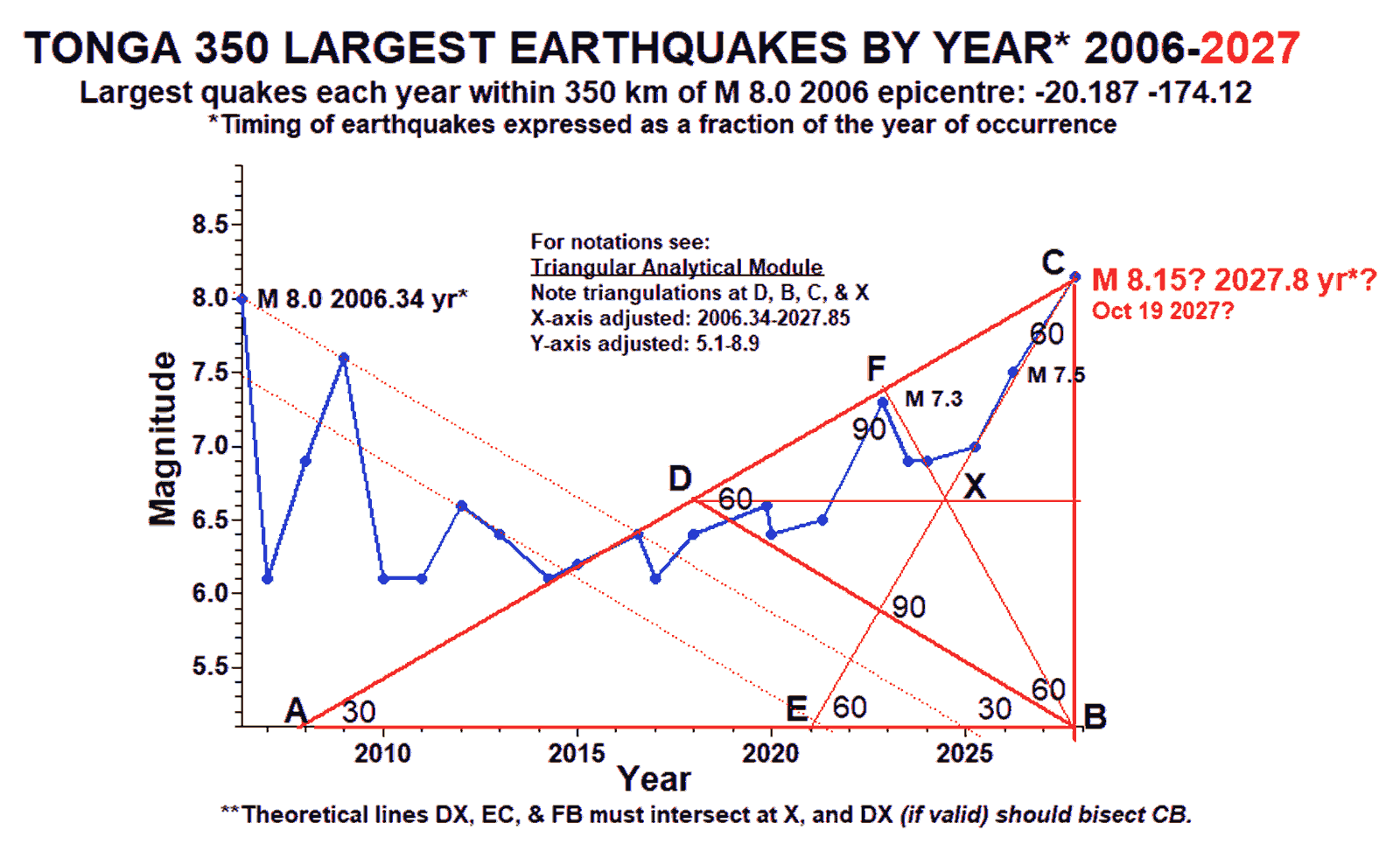
Figure 5

Figure 6
Discussion of Figures
Figure 5 shows that since 2014 the largest yearly magnitudes in a zone of 350 km radius around the 2006 M 8.0 epicentre have been increasing strongly (P<0.0001) towards the likely recurrence of another M 8 mainshock in this region, possibly by 2027, as already forecast on this website and indicated in Figure 5 with theTriangular Analytical Module.
There are strong contrasting trends between Figures 1 and 5: the former (zone 500 km in radius and over twice the area of the 350-km zone analysed for Figure 1) shows a long period of decline preceding the previous M 8.0 of May 3, 2006, versus the current long period of rise in annual magnitudes shown Figure 5. This highlights the need for comparative studies because the larger the zone the more likely it will include events belonging to the diverse dynamics of previous and/or imminent mainshocks, whereas somewhat smaller regions of around 350 km radius are usually quite 'homogeneous'.
As shown in Figure 6, the highly resonant angle of 30 degrees between the arms of separate sets of parallel lines is supportive of the analysis and forecast showing converging lines and resolution to a date of Nov 6, 2027, for the forthcoming mainshock which is likely to be approximately an M 8.15 earthquake - a date and magnitude that agrees closely and differs by less than one month with the forecast derived from application of the Triangular Analytical Module (Figure 5). This figure is also a good example of a long-term analysis spanning 20 years and now using that past data to make a trial forecast for a large earthquake due 15 months ahead. There are now month-by-month opportunities for the author to adjust and upgrade the forecast as needed, including input from the monthly timing and magnitude modules as in Figures 3 and 4.
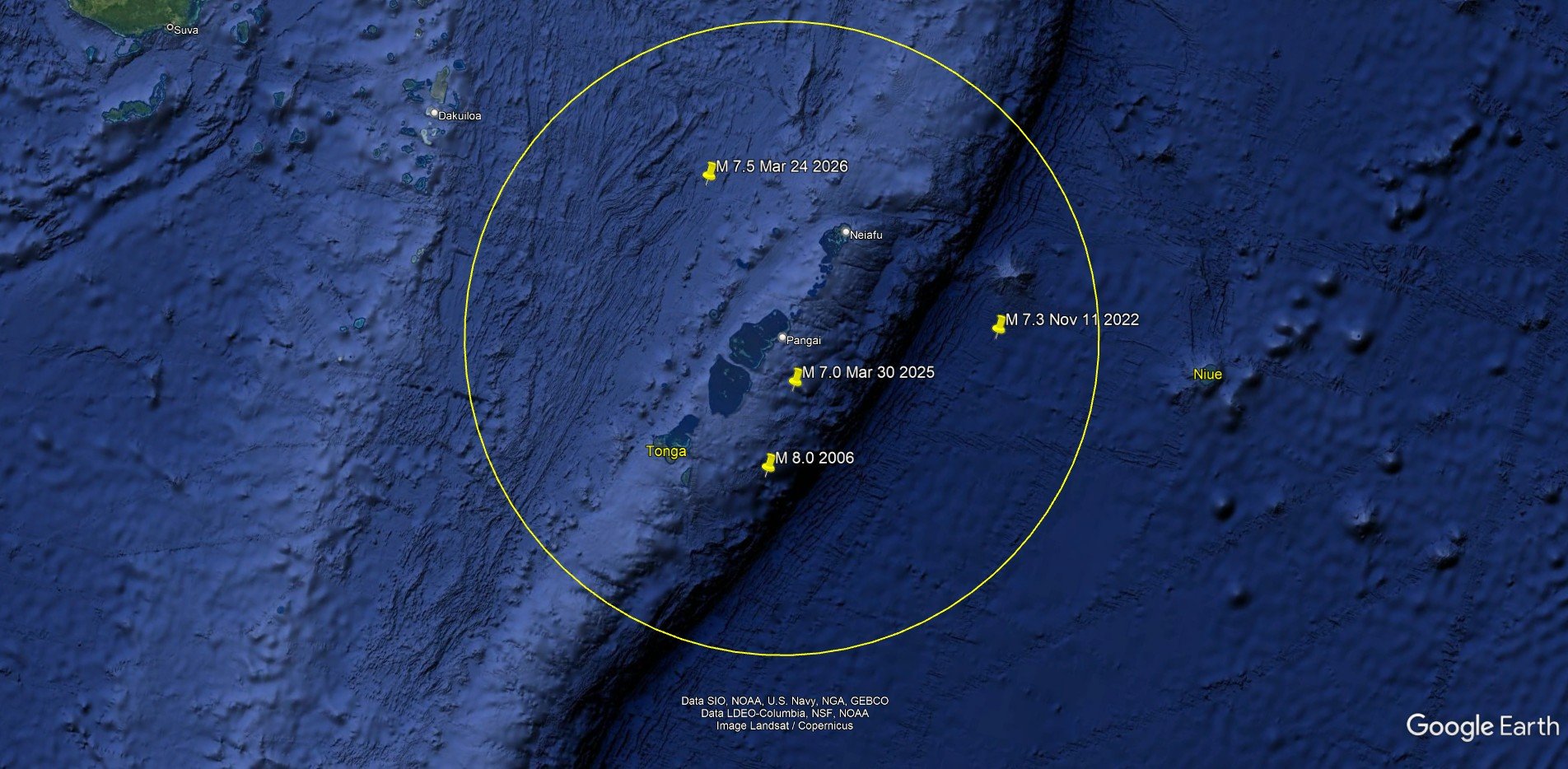
Google Earth Pro map showing the location of the largest recent earthquakes in relation to the previous M 8.0 of 2006, within a radius of 350 km from Pangai, Tonga. https://earthquake.usgs.gov/earthquakes/map/
**Data were analysed with a spline curve generated using GraphPad Prism version 5.01 for Windows, GraphPad Software, San Diego, California USA, https://www.graphpad.com
This page is in process of being updated…
Latest update: 13 July, 2026, 2026.