
Southern California
The region chosen for this study includes the cities of Los Angeles and San Diego which have experienced several large earthquakes since 1950, with the prospect of another one very soon, according to the author’s analyses below.
All Southern California’s important earthquakes have occurred in this study zone which has a radius of 350 km from the co-equal largest regional earthquake – the M 7.3 ‘Landers Earthquake Sequence’ of June 28, 1992 (Lat. 34.20, Lon -116.437) near Joshua Tree CA. Other very important earthquakes were:
1952 Kern County Earthquake M 7.3 July 21
1971 San Fernando Earthquake M 6.6 Feb 9
1992 Landers Earthquake Sequence M 7.3 June 28
AI Overview described these as ‘the most important and impactful earthquakes in Southern California since 1950’. Then it lists three ‘major and destructive earthquakes’ which have ‘reshaped infrastructure, prompted widespread building retrofits, and significantly advanced regional seismic monitoring’:
1994 Northridge Earthquake M 6.7 Jan 17
1992 Landers Earthquake Sequence M 7.3 June 28
2019 Ridgecrest Earthquake Sequence M 7.1 July 5
For more information on the above events review Wikipedia List of Earthquakes in California. There have also been two other large earthquakes not mentioned above, but included within the author’s study zone as given above:
1999 Hector Mine Earthquake M 7.1 Oct 16
2010 Baja CA Earthquake M 7.2 Apr 4
The purpose of this website is to share in the unfolding development of a promising and completely new research approach to forecasting large earthquakes like those above from the viewpoint of an ecologist, rather than a seismologist, and with the altruistic aim of saving lives and property.
This new approach is covered in the Ecological Model Overview and the six modules supporting it. It has made it possible for the first time to forecast the magnitude and timing of a large California earthquake - the M 7.0 Cape Mendocino offshore earthquake of Dec 5, 2024.
Successful prospective forecast for M 7.0 earthquake offshore Cape Mendocino.
The exact magnitude and day of this earthquake was forecast by the author’s ecological and mathematical modelling, and the event fell as expected within 150 km of the Cape and was advised ahead by email to several contacts in Australia and California.
During the analyses of earthquakes for all California leading up to this above M 7.0 event, the author noted high levels of interaction and connection with the southern end of the San Andreas state-long fault system and has posited that if a new M 7 earthquake occurs soon in Southern CA, it could act as a ‘foreshock’ of the right magnitude to the possible M 8 event at the southern end of the Cascadia Subduction Zone (between offshore mid Oregon to Cape Mendocino) which he expects in the near term from the modelling presented on this website (see Cascadia Subduction Zone).
Since September 2025, the author’s Triangular Analytical Module has been developed towards finding a complete geometric predictive module of the largest earthquakes occurring each lunar month and year. It was developed based on retrospective
forecasts and is now in the process of testing prospective forecasts like the one below. The module has profound implications and potential for more precise and reliable forecasts which are now being tested and refined as needed. The graphs below are excellent examples of this module and its application.
Retrospective Forecasts with Events Leading to Previous 2019 M 7.1

Figure 1 ^

Figure 2 ^
Prospective Forecasts with Events Leading to likely M 6.8-6.9

Figure 3
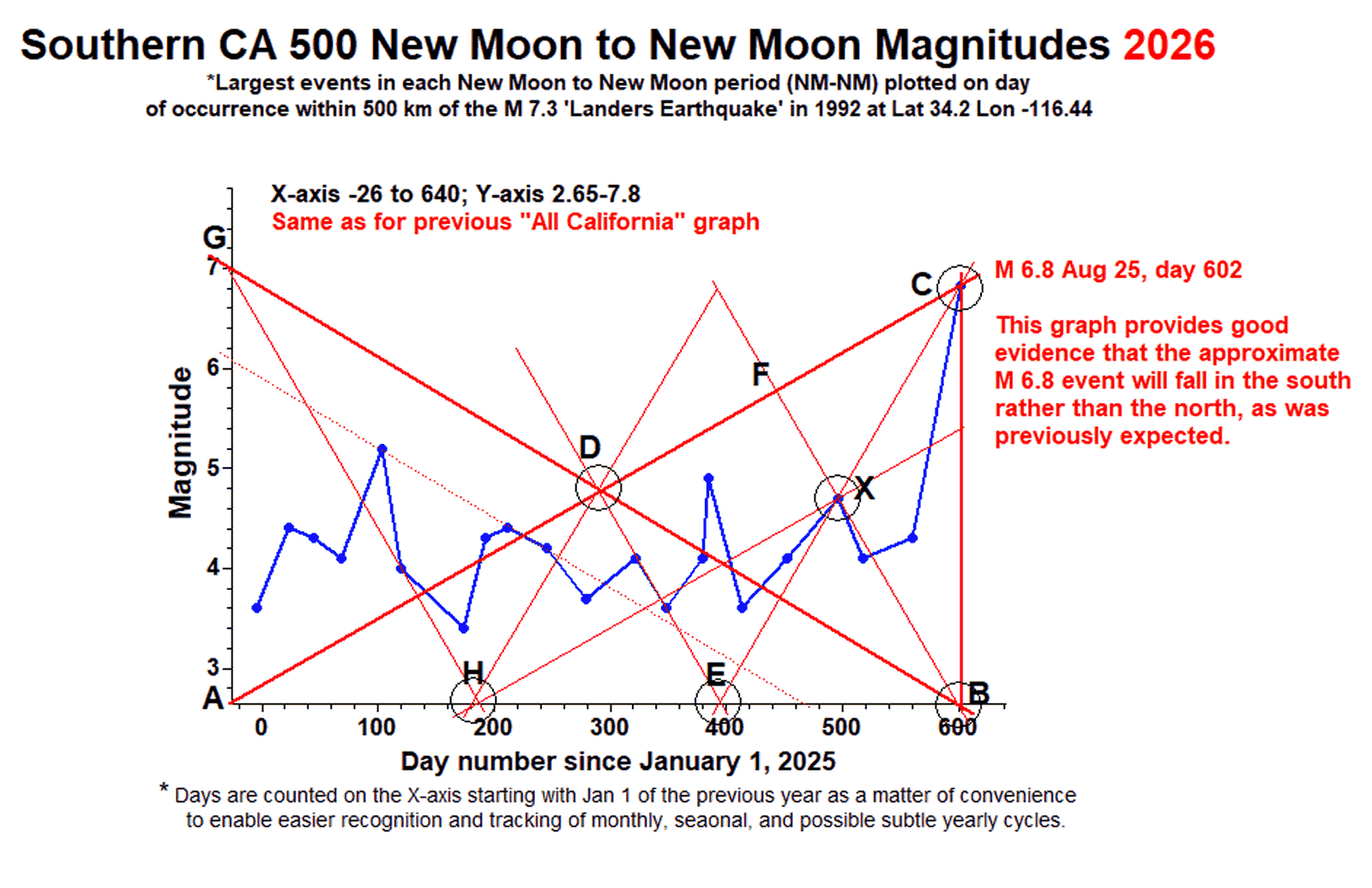
Figure 4
Discussion of Figures 1-4
These figures highlight the potential accuracies and reliability of forecasts based on the Triangular Analytical Module. With five simultaneous triangulations at B, C, D, X, and H, plus a key intersection on the X-axis at E (as in Figure 3) there seems to be little room for error apart from accumulative inaccuracies due to plotting the various angles and ‘reading’ the end-point triangulations, even with fine lines and enlarged figures. Some twelve to fifteen prospective forecasts will be needed to make a preliminary determination of the error margins associated with using this new module. There may also be further changes in application of the module to a data set. In any event, there must be final agreement between the outcomes of the various research modules, and in this regard the Triangular Analytical Module does not stand alone.
Profoundly interesting features of Figures 1-4 are the highly resonant angles of 30, 60, 90 and 120 degrees which are great descriptors applying here to measures of earthquake magnitude in relation to time. These angles form the equilateral triangle DBC and the adjacent isosceles triangle ADB which comprise the standard triangle ABC. However, their most powerful features are their interconnecting lines and triangulation points which show great potential for very accurate forecasts of both the timing and magnitude of a forthcoming mainshock.
Mainshock earthquakes make their final big jump on the vertical BC and sometimes this perpendicular leg of the triangle includes a very late foreshock, like the M 6.4 two days before the M 7.1 in Figure 1. Occasionally in world events the author sees such a foreshock in the final hour before a mainshock.
The mathematical ‘orthocentre’ X of the equilateral triangle DBC sits on the horizontal line DX and, as a penultimate point before the mainshock at C, it is one of the most important of the five triangulation points (Figure 3). The axes must be adjusted to meet these triangulations which form on a notional ‘grid’ of 30-degree and 60-degree lines.
There is a remarkable degree of synchronicity in earthquake patterns throughout California as revealed by Figures 3-4: application of the Triangular Analytical Module to events occurring along the Pacific Plate boundary and San Andreas fault system throughout the entire State of California (Figure 3) gives an analysis expecting an M 6.8-6.9 earthquake about August 25 (UTC), 2026.
The corresponding analysis for just Southern CA (Figure 4) gives the same result or expectation with different earthquakes plotted on axes with the same dimensions as for Figure 3. This supports our previous expectations for a strong to major earthquake occurring during August 2026, in the Los Angeles-San Diego region.
Figures 3 and 4 now represent our latest understanding and update in application of the potentially powerful Triangular Analytical Module which is currently being tested.
Note: This page to be updated as previous forecast was withdrawn on Aug 19 (UTC) 2026. An approximate M7 now not expected until 2029.
Page updated 19 Aug, 2026